the first of three nights, and the only one I stayed for
I don’t choose the nights. They’re given to me — handed over whole, end first, the way you might be handed a letter you’ve already read. By the time I find the door I know what’s behind it. By the time I learn the town is called Mischung — a mixing, a place where humans and elves and dwarves and halflings had agreed, some generations back, to be happy in the same narrow streets and mostly managed it — I already know it burns.
That is the whole of what I am. I arrive at the end and walk backward into the evening, and I can watch all of it, every lamp and every face, and I cannot touch a single one. I can’t lean down and tell the boy to stay near the gate. I can’t knock the cup out of the dwarf’s hand. I am not here to change the night. I am only ever the one who knew.
So when I step inside and the lamps are still lit, I am already grieving, and the people don’t know that yet — that is the cruel half of it. I stand in the doorway of the best evening they will ever have and think: poor things, the worst of it hasn’t even started.
Come stand with me a while. The party’s still going.
The lord’s house sat at the highest point of the town, a wood-framed fort gone soft with age, its courtyard open to the sky like a cupped hand. Tonight the whole of Mischung was inside it. The old lord had thrown the gates open, set out free wine and free bread, more than anyone could finish — the kind of generosity that looks, from a distance, like a town being tucked in for the night.
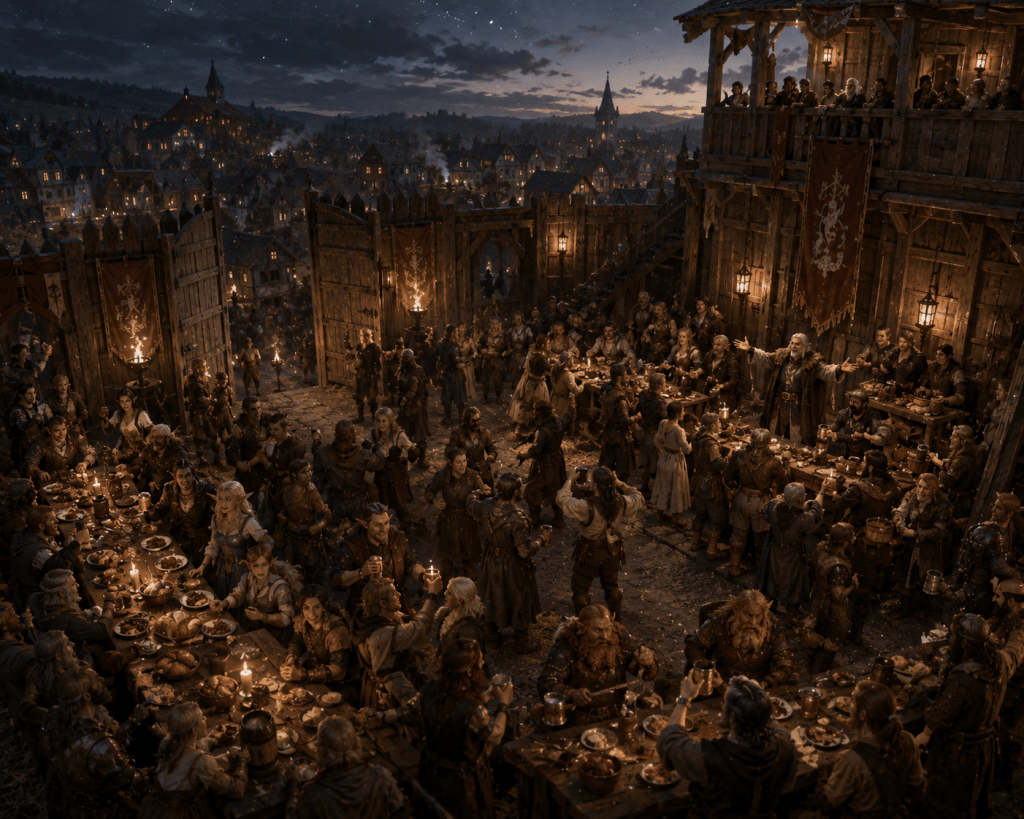
The party was for the four of them. They had been inseparable since the first morning of school: the lord’s son, an elf, a dwarf, a halfling. No one could remember choosing it; they had simply arrived as a set. Now school was behind them and a journey was ahead — a graduation trip, they called it, though no one had said yet where the road went. That was the thing being celebrated. The going.
If you watched the boy closely you could see he wasn’t really at his own party. His parents were having one of their silences. Not a fight you could point to — a cold one, the kind that fills a house from the floor up, that a child grows inside until he mistakes it for weather. No one knew the reason. There may not have been a reason left, only the silence itself, kept alive out of habit. Halfway through the evening it cracked open again, low and vicious under the music, and the boy did what he always did. He left.
He went out the back gate and down the slope behind the house, where the noise thinned to nothing and the dark was honest.
Something far off caught his eye.
For one breath he let himself believe it was fireworks — that his parents had arranged this too, a surprise, light over the rooftops. Then the wrongness of it reached him. The light was in the wrong places. It was under the roofs. The whole of Mischung below him, everything but the hill he stood on, had been set into a single slow fire.
He ran back up the slope, stumbling, going down twice on the wet grass and not feeling it.
Before he reached the gate he saw the shadow.
It stood in the courtyard, quiet, as if it had been invited. He held his breath and crossed toward it, soft-footed, the way you approach something you don’t want to startle. He got close enough to take it — and lunged, and his hands closed on cold and nothing. The shadow had no body. There was only the shape of one, the want of one.
And the boy knew it.
His family had kept a ring since before the town had a name — a duty so old it had thinned into a bedtime story, the way you tell children about wolves. He had found the rest in a book passed down the long way, hand to hand for centuries: that the ring had nine who came for it, who had given up their bodies somewhere along the road and kept only the coming. If one of them is here, the book said, in so many words, the others are already on their way.
The shadow turned, unhurried, and was gone — not fled, just no longer choosing to be seen.
While the boy stood in the empty courtyard trying to make his legs work, the elf was at the far gate with the halfling, and three of them had her surrounded.
She was not the brave one. She had never pretended to be. But the halfling was her friend, and was small, and was behind her, and that arranged the question simply. She did the thing she had been warned never to do young — she reached for the time magic, the deep kind, the kind that takes more out of an elf than an elf that age has to give. The courtyard held its breath. The rain hung in the air. She got them both back through the door in the long, ringing second before the world thawed, and then she sat down very hard on the floor and could not stand for a while.
The dwarf had the worst of it and the best of it at once. He had gone looking for the loo, gloriously drunk, and met a shadow taller than the doorway, and his only thought — clear, almost peaceful — was that he had finally, finally had too much, and what a relief to know it. He was still smiling at the creature when the boy caught his arm hard enough to bruise and said the only word left worth saying.
“Run.”
Inside, the hall had become something no one in living memory had a word for. Crying, the small animal kind. The whole town pressed into one room, which had seemed like a blessing an hour ago and now meant only that they were all in one room together when it came.
All of them but one.
“What about auntie?” the boy said, when his voice came back. His father’s sister — the old lord’s little sister — had been living out in the wood since the quarrel, the great one no one explained, the one that had simply ended the way the silence in this house ended things: not in peace, in distance.
The elf got her feet under her. “I can flash to the trees and back. I can—”
“No.” The old lord didn’t raise his voice, which was worse. “You four leave now. With the ring. Don’t waste yourself on her.”
The boy looked at his father and understood, all at once, that the cold in this house and the cold toward the woman in the woods were the same cold, the same winter wearing two coats — and he opened his mouth to say so, to ask how a man could weigh his own sister and decide she came out lighter than an errand —
A shadow stepped into the hall. Into the light. Into the middle of every person his family was sworn to keep.
“Elf,” the old lord said. “Now.“
And this is where I stop.
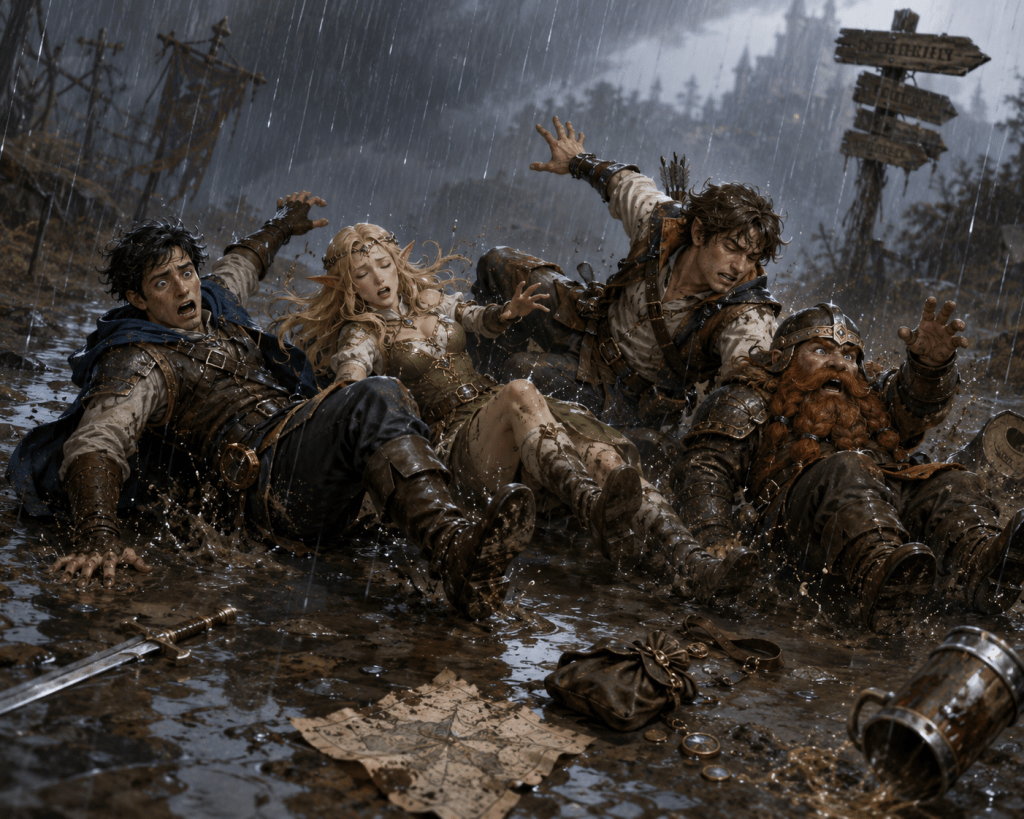
The night ends with four children dropped into the square of the neighboring town, into a rain that has clearly been falling for hours and means to fall for hours more. Soaked through. Holding one another up. Alive — which, by morning, they will decide was the whole of the disaster, and that it is behind them now.
I stand a step away, close enough to count the water running off the dwarf’s beard, and I do what I always do, which is nothing. I have already seen the second night, and the third. I have stood in the ash of this town and in the ash of others — too many nights, all of them bending the same way at the end, toward the moment the hope goes out of people’s faces. I have watched it so often that tonight the thing I always half-knew finally surfaces all the way: none of this is happening. I am asleep. The dream is mine.
And there is a question the boy never got to ask. The shadow took the hall before he could finish it — how can you look at your own sister and decide she isn’t worth the cost. I am about to become its answer. Don’t waste yourself on her, his father said; and here I am, declining to waste myself on a town I was never able to save. I have the old man’s sentence by heart now. Maybe that makes me the cold one. Maybe looking away is only the courteous word for it, and everyone reaches, sooner or later, a doorway they choose not to walk through.
But the father had a hand and kept it in his pocket, and I have no hand at all — only eyes, and eyes held open over a wound they cannot close don’t heal anyone. They only learn, slowly, to stop seeing. That is the thing I am trying not to become. And there is one difference I’ll keep against the charge: he left his sister in the woods and let the evening close over her, while I am leaving and taking the night with me. I wrote it down — every lamp, every face, the elf gone quiet on the floor, the dwarf’s terrible peaceful smile. No one carries a thing that carefully out of a burning house unless some part of them refuses to let it have been nothing.
Whether that is mercy or only the first cold habit, I won’t know tonight. The answer never comes at the doorway. It comes later — in whether I come back.
So I keep them in the rain a little longer, while they are still glad — they got out, and that much I’ll hold — and then I let myself wake.
 bob in troop
Leave a comment