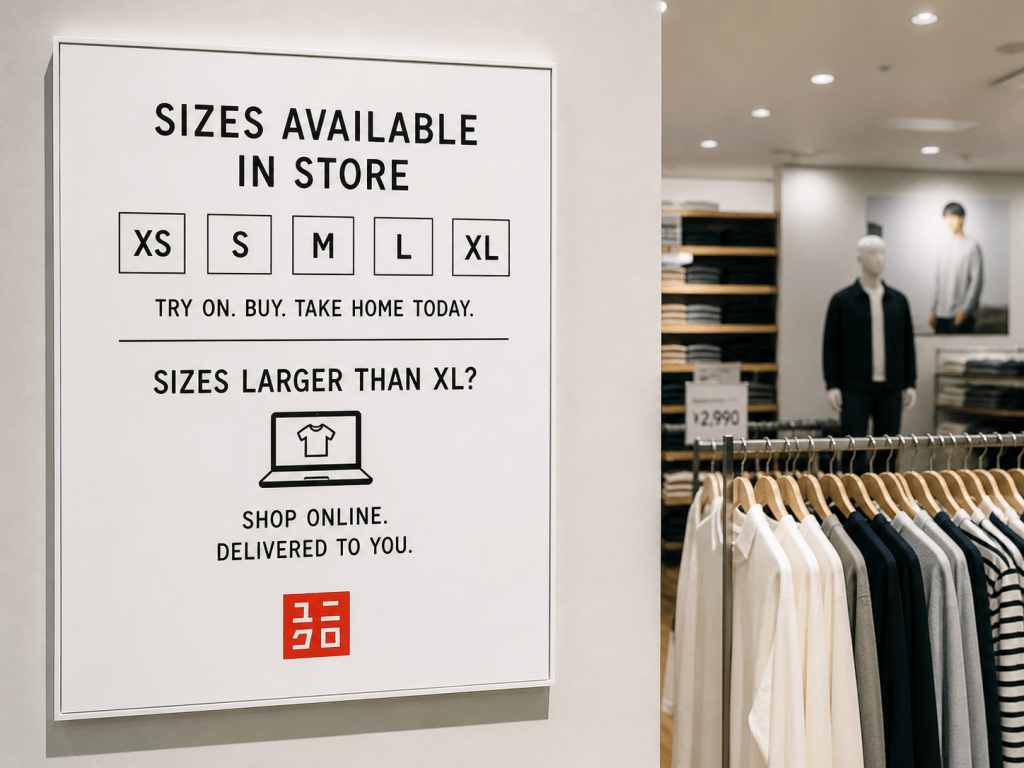
Today I was at Uniqlo trying to run a summer wardrobe haul. Berlin has been hotter than me since this morning.
Suspecting they might have limited size options for some models, I’d checked the Uniqlo app beforehand, selected the specific store I was planning to visit, and added a few items that showed in-store stock to my basket.
Once I got there, I wandered around only to find that nearly every size table carried the same line: larger sizes (from XXL) available online. For a moment, I felt that people like me had been quietly excluded from the in-store shopping experience, that old-fashioned but convenient ritual where you see something, try it on, and walk out with it.
I can grant there’s probably a statistically backed business case behind this: supply chain, inventory turnover, store square-footage, maybe wider considerations I’m not seeing. What I don’t understand is why an exception couldn’t be made for their most popular models. To be fair, Uniqlo is already one of the few affordable brands offering a relatively full size range. Part of me wishes I were angry enough to boycott them outright, but doing so would basically leave me with nothing to wear.
This loosely parallels an earlier experience: a sexual harassment incident during a Bolt ride. I know they could do better, and ought to do better, to make rides safer not just for AFAB passengers but also for gender-nonconforming and trans people. Some companies, Bolt included, have introduced a women-drivers-for-women-passengers option in two major German cities. That’s a good first step, but it’s far from enough. There’s a decision somewhere behind this: choosing those two cities over others, and choosing “women for women” rather than, say, “women for FLINTA*.” But as someone whose commuting depends heavily on Bolt and Uber, refusing their services outright isn’t realistic either.
In this sense, whether you’re clinically obese, gender-nonconforming, trans (the list goes on), your everyday life is shaped, and quietly constrained, by decisions someone else made. And as a customer, you can’t really do much about it when those services are ones your life genuinely depends on.
It reminds me of an Instagram reel I once saw about hostile architecture: park benches deliberately designed to discourage sitting too long, let alone lying down. Those design choices exist precisely to constrain the lives of certain groups.
I’m fairly sure regulators could do something about all of this. As to why they don’t, my working theory:
- They aren’t aware these issues exist.
- They don’t treat them as urgent or severe enough to prioritise.
- These are private-sector decisions, and free-market norms discourage public authorities from intervening too far.
In my view, a better future society can’t simply gamble on the public’s collective goodwill. Some guidelines need to exist to nudge private organisations toward serving a wider range of people. I’m not arguing for authoritarian power. I’m arguing for a society that takes everyone’s lived experience seriously.
 bob in troop
Leave a comment